
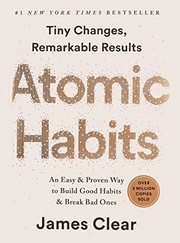
Review: Atom Habits: An Easy & Proven Way to Build Good Habits & Break Bad Ones by James Clear
In a Nutshell
Master the art of small changes with James Clear's Atomic Habits, a practical guide to building good habits & breaking bad ones through incremental progress.
In a world saturated with grand, sweeping pronouncements on self-improvement, James Clear’s *Atomic Habits* offers something refreshingly granular. It’s a book that doesn’t just promise transformation, but dissects the very mechanics of it, revealing how the tiniest shifts can precipitate monumental change. The power, Clear argues, lies not in Herculean efforts, but in the quiet consistency of seemingly insignificant actions, building upon themselves like compound interest.
At its core, *Atomic Habits* is a practical guide to building good habits and breaking bad ones, framed through the lens of small, sustainable changes. Clear eschews the often-cited need for dramatic overhauls in favor of a system focused on incremental improvements – the “atomic” habits that form the building blocks of remarkable results. He meticulously lays out a four-step framework: Make it Obvious, Make it Attractive, Make it Easy, and Make it Satisfying, along with its inverse for breaking bad habits. The book is less about motivation and more about designing environments and systems that make desired behaviors inevitable.
What works beautifully in *Atomic Habits* is its unflinching commitment to actionable advice. Clear’s prose is clear, concise, and remarkably devoid of jargon, making complex psychological principles accessible to anyone. He masterfully weaves together compelling anecdotes, scientific research, and personal experiences to illustrate his points. The framework itself, with its four laws of behavior change, feels both intuitively sound and rigorously tested. I found myself returning to his examples of athletes and artists, not just for inspiration, but for concrete strategies I could immediately implement. The “Two-Minute Rule,” for instance, which encourages starting a new habit by doing it for less than two minutes, is a stroke of genius in overcoming initial inertia. It’s a book that consistently offers “aha!” moments, prompting a re-evaluation of one’s daily routines. Unlike some self-help gurus who offer platitudes, Clear provides a blueprint, a toolkit, and the encouragement to use it effectively.
If there’s an area where *Atomic Habits* could perhaps be strengthened, it’s in the nuance of individual differences. While Clear acknowledges that what works for one person may not work for another, the emphasis remains heavily on the universal applicability of his framework. For those grappling with deeper psychological hurdles, such as severe anxiety or depression, the book’s solutions, while effective for habit formation, might feel insufficient as a standalone remedy. The focus on systems, while powerful, can sometimes overlook the significant emotional and psychological barriers that prevent people from even reaching the starting line. Additionally, while the book is packed with strategies, a more robust exploration of how to navigate setbacks and plateaus, beyond the initial advice, might have been beneficial for long-term adherence.
Ultimately, *Atomic Habits* is more than just a book about habits; it’s a philosophy of progress. It’s a powerful testament to the idea that significant achievement is the byproduct of consistent, small actions. Readers will leave with a profound understanding of how their daily routines shape their identity and a practical, step-by-step guide to consciously architecting a better future. It’s the kind of book that doesn’t just sit on your shelf, but actively reshapes the way you live your life, one tiny habit at a time. It’s a gem for anyone seeking genuine, sustainable personal growth.
More Reviews

Review: The Audacity of Hope: Thoughts on Reclaiming the American Dream by Barack Obama
by Barack Obama

Review: Six of Crows by Leigh Bardugo
by Leigh Bardugo
Review: The Difficulty of Being Good: On the Subtle Art of Ethics by Gurcharan Das
by Gurcharan Das