
Review: Atomic Habits: An Easy & Proven Way to Build Good Habits & Break Bad Ones by James Clear
In a Nutshell
James Clear's 'Atomic Habits' offers a pragmatic, science-backed framework for building good habits and breaking bad ones through small, consistent changes.
In a world saturated with self-help advice, much of which feels ephemeral or overly simplistic, James Clear’s "Atomic Habits" arrives not with a bang, but with the quiet, insistent power of a well-laid plan. It’s a book that doesn’t just promise transformation; it meticulously outlines the architecture of it, grounded in the understanding that significant change is rarely the result of a single, dramatic event, but rather the compounding effect of tiny, consistent efforts. The cultural moment is ripe for such a guide; we are bombarded with the allure of overnight success, yet yearn for sustainable growth. Clear taps into this tension, offering a pragmatic framework that feels both revolutionary and deeply sensible.
At its core, "Atomic Habits" is a user manual for self-improvement, eschewing grand pronouncements for a focus on the incremental. Clear posits that true, lasting change comes not from radical overhauls, but from mastering the art of showing up, consistently, in small ways. He introduces the concept of “atomic habits” – minuscule, fundamental adjustments that, like atoms, form the building blocks of larger systems. The book demystifies the process of habit formation and breaking, guiding readers through the practical application of four simple laws: make it obvious, make it attractive, make it easy, and make it satisfying. It’s about optimizing your environment, understanding your identity, and leveraging the power of small wins to create remarkable results over time.
What works beautifully in "Atomic Habits" is its rigorous, almost scientific approach to a topic often mired in anecdote and aspiration. Clear draws on a rich tapestry of research from biology, psychology, and neuroscience, but he presents these concepts with remarkable clarity and accessible prose. Unlike many habit books that rely on motivational platitudes, Clear offers actionable strategies. His four laws are not abstract ideals but concrete tools that can be immediately implemented. For instance, the concept of "habit stacking" – linking a new habit to an existing one – is a deceptively simple yet powerful technique. Similarly, the emphasis on redesigning your environment to support your desired habits, rather than relying solely on willpower, is a game-changer. I found myself mentally rearranging my own workspace as I read, visualizing how small environmental tweaks could nudge me towards greater focus. The book’s structure, too, is masterful, building logically from the foundational principles of identity-based habits to the practicalities of implementation. It feels like a well-structured course rather than a collection of ideas.
Furthermore, Clear’s exploration of identity-based habits is a profound differentiator. He argues that the most effective way to change your habits is to focus on the *type* of person you wish to become, rather than solely on the outcomes you want to achieve. This subtle but crucial shift reframes self-improvement from a task-oriented endeavor to an identity-affirming one. When you believe you are the kind of person who ______ (e.g., exercises regularly, reads voraciously, avoids processed foods), your actions naturally begin to align with that identity. This perspective adds a layer of psychological depth that elevates "Atomic Habits" beyond a mere how-to guide. It resonates with the principles espoused by thinkers like Stephen Covey in "The 7 Habits of Highly Effective People," but offers a more granular, mechanism-driven approach to enacting those principles in daily life. The sheer number of practical examples, from athletes to business leaders, illustrating these concepts makes them tangible and inspiring.
If there’s an area where "Atomic Habits" could be strengthened, it might be in its handling of deeply ingrained, complex psychological barriers to habit change. While Clear provides an excellent framework for building new habits and breaking simpler bad ones, the book occasionally touches upon, but doesn’t fully excavate, the profound emotional or psychological roots that can make certain habits incredibly tenacious. For readers grappling with issues like addiction, severe procrastination stemming from anxiety, or trauma, the four laws, while beneficial, might feel insufficient on their own. They provide the ‘how,’ but the deeper ‘why’ of resistance sometimes requires more than environmental tweaks or identity affirmations. While Clear acknowledges the role of motivation and belief, a deeper dive into therapeutic approaches or more complex psychological interventions could have provided an even richer resource for those facing significant headwinds.
However, this is a minor point in an otherwise exceptional work. The book’s strength lies in its universality and applicability to the vast majority of common habits that shape our daily lives. Clear’s prose is consistently engaging, avoiding the jargon and hyperbole that can plague the genre. He manages to be both authoritative and empathetic, presenting a system that feels achievable rather than daunting. The pacing is superb, with each chapter building upon the last, ensuring the reader is equipped with the knowledge and tools to progress. It’s the kind of book that warrants rereading, not because it’s difficult, but because its practical wisdom reveals itself in new ways as you attempt to apply it.
Ultimately, "Atomic Habits" is a masterclass in the science and art of self-improvement. It’s a book that empowers readers by demystifying the process of change, offering a clear, actionable, and profoundly effective path to building better habits and achieving meaningful goals. It’s not about radical transformation overnight, but about the steady, reliable power of small improvements compounding over time. Readers will walk away with not just a strategy, but a fundamental shift in perspective, understanding that the quality of their life is a direct reflection of the quality of their habits. This is essential reading for anyone seeking sustainable personal growth.
More Reviews
Review: The Audacity of Hope: Thoughts on Reclaiming the American Dream by Barack Obama
by Barack Obama

Review: Six of Crows by Leigh Bardugo
by Leigh Bardugo
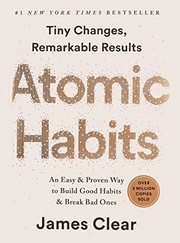
Review: Atom Habits: An Easy & Proven Way to Build Good Habits & Break Bad Ones by James Clear
by James Clear