
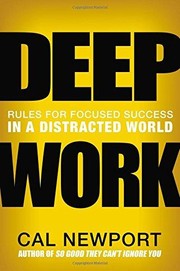
Review: Deep Work: Rules for Focused Success in a Distracted World by Cal Newport
In a Nutshell
Cal Newport's "Deep Work" argues that focused, distraction-free concentration is essential for valuable output and personal fulfillment in today's world.
In an era where the siren song of distraction plays a constant, deafening anthem, Cal Newport’s *Deep Work* arrives not just as a guide, but as a desperately needed manifesto. We are awash in notifications, pulled in a thousand digital directions, and in this fractured landscape, the capacity for sustained, undistracted thought has become a rare and powerful commodity. Newport argues, quite convincingly, that this ability – the very essence of deep work – is not only the key to producing high-quality output but also a fundamental pathway to fulfillment.
At its core, *Deep Work* is a compelling argument for cultivating the ability to focus without distraction on cognitively demanding tasks. Newport posits that this skill, which he defines as "professional activities performed in a state of distraction-free concentration that push your cognitive capabilities to their limit," is increasingly rare and therefore increasingly valuable in our economy. He meticulously dissects the forces actively eroding our ability to engage in deep work – the pervasive culture of shallow connectivity, the addiction to fragmented communication, and the rise of "open office" architectures – and then, crucially, offers a robust toolkit of strategies for reclaiming our attention and mastering this vital skill. This isn't a book about time management in the traditional sense, but about attention management, a far more critical currency in the 21st century.
What truly elevates *Deep Work* beyond a mere self-help tract is Newport’s rigorous blend of scientific research, philosophical inquiry, and anecdotal evidence. He doesn't just tell you *what* to do; he explains *why* it works, drawing on studies in psychology, neuroscience, and even the biographies of immensely productive individuals. His exploration of the "four philosophies" of deep work – the monastic, the bimodal, the rhythmic, and the journalistic – offers a nuanced understanding that acknowledges different personalities and professional demands. I found myself particularly struck by his emphasis on embracing boredom and deliberately scheduling downtime, concepts that run counter to our cultural obsession with constant productivity. The way he frames the deliberate practice of focus, akin to the training regimes of elite athletes, makes the pursuit of deep work feel both achievable and profoundly rewarding, resonating with the disciplined approach I’ve admired in writers like Annie Dillard when discussing her own creative process.
Newport’s prose is remarkably clear and engaging, devoid of the jargon that often plagues business books. He has a talent for distilling complex ideas into actionable advice, making the daunting prospect of transforming one’s work habits feel less overwhelming. The case studies he presents, from the intense focus of Carl Jung to the disciplined routines of the journalist and novelist Walter Isaacson, provide vivid illustrations of deep work in action. He masterfully debunks the myth that constant connectivity and multitasking are indicators of high performance, instead demonstrating how they actively hinder meaningful progress. The book’s strength lies in its practical, step-by-step approach, providing readers with a clear roadmap to build their own deep work muscles, much like a seasoned coach guiding an athlete through a rigorous training program.
If there’s a point where *Deep Work* could be stronger, it might be in the sheer volume of prescriptive advice. While the thoroughness is commendable, some readers might find the sheer breadth of strategies a bit overwhelming, potentially leading to a form of "analysis paralysis." Newport himself acknowledges that not every strategy will work for everyone, but the sheer number of techniques presented could, paradoxically, lead to distraction if not approached with deliberate intention. Additionally, while the book excels at outlining *how* to achieve deep work, it perhaps could have delved a little deeper into the psychological *resistance* many individuals face, beyond the allure of social media. The challenges of ingrained habits and the societal pressures to be constantly available are immense, and a more extended exploration of overcoming these internal and external barriers could have been beneficial.
Ultimately, *Deep Work* is an indispensable read for anyone feeling overwhelmed by the demands of the modern professional landscape and yearning for a more meaningful, impactful way to work. It's a profound and timely reminder that the ability to concentrate is not a relic of the past, but a vital skill for future success and personal satisfaction. Newport doesn't just offer solutions; he provides a philosophy for a more deliberate and fulfilling professional life, leaving the reader with the distinct impression that true mastery, and indeed happiness, lies not in the breadth of our connections, but in the depth of our engagement. You’ll close this book not just informed, but inspired to reclaim your most valuable resource: your attention.
More Reviews

Review: The Audacity of Hope: Thoughts on Reclaiming the American Dream by Barack Obama
by Barack Obama

Review: Six of Crows by Leigh Bardugo
by Leigh Bardugo
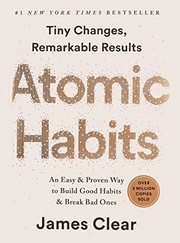
Review: Atom Habits: An Easy & Proven Way to Build Good Habits & Break Bad Ones by James Clear
by James Clear