
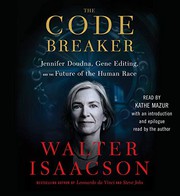
Review: The Code Breaker: Jennifer Doudna, Gene Editing, and the Future of the Human Race by Walter Isaacson
In a Nutshell
Walter Isaacson's "The Code Breaker" illuminates Jennifer Doudna, CRISPR gene editing, and the profound ethical future of humanity.
Walter Isaacson has a knack for making the complex accessible, and in "The Code Breaker," he turns his formidable biographical lens onto the world-changing discovery of CRISPR gene editing and the brilliant, driven scientist at its heart, Jennifer Doudna. This is not merely a chronicle of a scientific breakthrough; it's an exploration of ambition, collaboration, fierce competition, and the profound ethical quandaries that arise when humanity gains the power to rewrite the very code of life.
At its core, "The Code Breaker" is the story of Jennifer Doudna, a biochemist who, alongside Emmanuelle Charpentier, was awarded the Nobel Prize for their pioneering work in developing CRISPR-Cas9, a revolutionary technology that allows for precise editing of DNA. Isaacson charts Doudna's journey from a curious child in Hawaii to a leading figure in molecular biology, meticulously detailing the scientific process, the academic rivalries, and the burgeoning ethical debates that accompanied the discovery. The book delves into the intricate mechanics of CRISPR, explaining its potential to cure genetic diseases, engineer crops, and perhaps even alter the human germline, all through Isaacson's signature engaging narrative style.
What works beautifully in "The Code Breaker" is Isaacson's unparalleled ability to translate dense scientific concepts into a compelling, narrative-driven experience. He doesn't shy away from the technicalities of gene editing, but he frames them within the human drama of discovery. The portrayal of Jennifer Doudna is particularly strong. Isaacson paints a nuanced portrait of a scientist who is both intensely focused and deeply thoughtful, grappling with the immense responsibility that comes with her work. The narrative pacing is masterful, mirroring the thrilling race to understand and harness CRISPR. Isaacson expertly weaves in the stories of other key players, such as Emmanuelle Charpentier and Feng Zhang, creating a rich tapestry of scientific endeavor. I found myself particularly struck by his depiction of the intense, almost gladiatorial competition among research labs, a dynamic that, while often accelerating progress, also raises questions about scientific integrity and the pursuit of fame.
Furthermore, the book excels in its exploration of the ethical landscape surrounding gene editing. Isaacson doesn't offer easy answers; instead, he presents the arguments from various perspectives, from those who advocate for therapeutic uses to those who warn of the dangers of designer babies and unintended consequences. The inclusion of conversations and debates with leading bioethicists and policymakers adds a crucial layer of complexity, highlighting the profound societal implications of this technology. This nuanced approach is reminiscent of his earlier work on Steve Jobs, where he explored the interplay between innovation and its impact on the world, but here the stakes feel even higher, touching upon the very essence of what it means to be human.
If there's a place where "The Code Breaker" could be stronger, it might be in slightly more deeply exploring the personal toll that such a demanding career and groundbreaking discovery takes on Doudna herself. While Isaacson touches upon her dedication, a deeper dive into her internal struggles or the sacrifices made might have added another layer of emotional resonance. Additionally, while the book does an admirable job of explaining the science, there are moments where the sheer volume of information might feel slightly overwhelming to the complete layperson, although Isaacson's prose generally keeps it engaging. A slightly more restrained approach in a few of the more technical sections might have further smoothed the reading experience for some.
Ultimately, "The Code Breaker" is a triumph of science biography, a book that makes you marvel at human ingenuity while simultaneously prompting urgent reflection on our collective future. It’s an essential read for anyone interested in the cutting edge of science, the ethics of biotechnology, or simply a compelling story of modern scientific discovery. You'll close the book not just more informed about gene editing, but profoundly aware of the power we now wield and the wisdom required to use it. Isaacson has once again delivered a masterpiece that illuminates a pivotal moment in human history.
More Reviews
Review: The Audacity of Hope: Thoughts on Reclaiming the American Dream by Barack Obama
by Barack Obama
Review: Six of Crows by Leigh Bardugo
by Leigh Bardugo
Review: Atom Habits: An Easy & Proven Way to Build Good Habits & Break Bad Ones by James Clear
by James Clear