
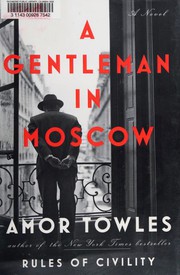
Review: A Gentleman in Moscow by Amor Towles
In a Nutshell
Confined to Moscow's Metropol Hotel, an aristocrat finds profound meaning and resilience through decades of historical upheaval, curated relationships, and the cultivation of an inner life.
Amor Towles's "A Gentleman in Moscow" is a glorious testament to the enduring power of grace, wit, and resilience in the face of profound upheaval. It’s a novel that reminds us, in the most elegant of ways, that a well-lived life is often built not on grand gestures, but on the quiet cultivation of the self and the relationships that sustain us.
At its heart, the novel tells the story of Count Alexander Rostov, a man of privilege and impeccable manners, who, in the wake of the Bolshevik Revolution, is sentenced by a Bolshevik tribunal to house arrest in Moscow's opulent Metropol Hotel. Stripped of his title and his former life, confined within the gilded cage of the hotel, the Count must navigate decades of seismic historical change, from the rise of Stalin to the Cold War, all while maintaining his dignity, his intellect, and his essential kindness. It’s a premise that could easily descend into claustrophobia or melodrama, but Towles, with a masterful hand, crafts a narrative that is expansive, philosophical, and deeply human.
What works so beautifully in "A Gentleman in Moscow" is its exquisite prose and the sheer joy Towles takes in language. His sentences are like perfectly aged wine, rich and nuanced, unfolding with a deliberate, almost leisurely grace that mirrors the Count's own approach to life. The hotel itself becomes a vibrant, microcosmic world, populated by a cast of unforgettable characters – the spirited Nina, the wise chef Emile, the resilient Sofia – each of whom enriches the Count's existence in unexpected ways. The pacing, far from being sluggish, feels like a deliberate, unhurried journey, allowing the reader to fully immerse themselves in the Count's meticulously curated world. I found myself drawn into the minutiae of his daily routines, the intellectual sparring with fellow residents, and the quiet observations that illuminate the human condition. It’s a novel that rewards patience, offering a depth of insight that many faster-paced narratives simply cannot achieve. The novel also possesses an almost Chekhovian quality, a keen understanding of the subtle tragedies and quiet triumphs that define our existence, all observed through the lens of an aristocrat forced to adapt to a radically different world.
While the novel is largely a triumph, there are moments where the sheer elegance of Towles's writing, while a strength, can also, paradoxically, feel like a slight impediment. Certain philosophical digressions, while beautifully articulated, occasionally slow the narrative momentum. The latter portion of the novel, while emotionally resonant, perhaps doesn't quite achieve the same spark of inventive surprise as the earlier sections. However, these are minor quibbles in the face of such a richly realized and affecting story. The world-building within the Metropol is so vivid that the moments where the Count ventures beyond its walls, while significant, feel almost less vital, a testament to the hotel's power as a narrative universe.
Ultimately, "A Gentleman in Moscow" is a profound exploration of what it means to live a meaningful life, not in spite of limitations, but because of them. It’s a novel for anyone who appreciates fine writing, compelling characters, and a story that lingers long after the final page. Readers will walk away with a renewed appreciation for the quiet heroism of everyday existence and the enduring elegance of the human spirit. It’s a reminder that even when confined, the mind and the heart can soar, creating a universe of their own.
**Summary:** Confined to Moscow's Metropol Hotel, an aristocrat finds profound meaning and resilience through decades of historical upheaval, curated relationships, and the cultivation of an inner life.
More Reviews
Review: The Audacity of Hope: Thoughts on Reclaiming the American Dream by Barack Obama
by Barack Obama
Review: Six of Crows by Leigh Bardugo
by Leigh Bardugo
Review: Atom Habits: An Easy & Proven Way to Build Good Habits & Break Bad Ones by James Clear
by James Clear