
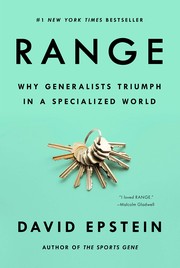
Review: Range: Why Generalists Triumph in a Specialized World by David Epstein
In a Nutshell
David Epstein's "Range" argues that broad exploration and delayed specialization foster greater success and innovation in a complex world.
We live in a world that relentlessly champions the specialist, the prodigy, the narrowly focused virtuoso. From childhood, we’re encouraged to pick a lane and accelerate down it, a mantra that David Epstein masterfully deconstructs in "Range: Why Generalists Triumph in a Specialized World." He argues, with compelling evidence and engaging storytelling, that the opposite approach – embracing breadth and delaying intense specialization – is often the surer path to genuine expertise and innovation.
Epstein’s central thesis is that while deep specialization can yield impressive results in predictable environments, the modern world is anything but. It’s characterized by “wicked problems” and “dangerously narrow thinking,” where the ability to connect disparate ideas, adapt to unforeseen circumstances, and think laterally is paramount. He draws on a vast array of examples, from chess grandmasters to jazz musicians, from scientists to entrepreneurs, to illustrate how individuals who cultivate broad experience and a wide range of skills often outperform those who commit to a single path too early. The book is not an argument against expertise, but a powerful plea for a more flexible, exploratory approach to developing it.
What truly elevates "Range" is Epstein's exceptional ability to weave together rigorous research with captivating narratives. He doesn’t just present data; he brings it to life through the stories of people who embody his arguments. Consider the chapter on the late-blooming success of Roger Federer, who didn’t find his true tennis stride until his mid-twenties, after dabbling in various sports. Or the insightful exploration of how successful scientists often have eclectic hobbies that fuel their creative breakthroughs, a point echoed in Malcolm Gladwell’s more anecdotal but thematically related explorations of success. Epstein’s prose is accessible yet sharp, avoiding academic jargon while still maintaining intellectual rigor. He has a knack for making complex psychological and sociological concepts feel intuitive, and I found myself nodding along, recognizing patterns in my own life and the lives of those around me.
The book excels in its dismantling of the “10,000-hour rule,” a popular but often misunderstood metric championed by Anders Ericsson. Epstein shows how this rule is often misapplied, particularly in “kind” learning environments where rules are clear and outcomes predictable. In contrast, he highlights the power of exploration and experimentation in “wicked” learning environments, where the rules are fluid and the path forward uncertain. This nuanced approach to skill acquisition is one of the book's most significant contributions, offering a refreshing counterpoint to simplistic advice on achieving mastery. The way he connects seemingly unrelated fields, such as the importance of grit in one domain and the value of diverse experiences in another, is particularly striking and underscores the interconnectedness of human development.
If there’s an area where "Range" could perhaps be even stronger, it might be in offering more explicit, actionable strategies for individuals actively seeking to pivot from hyper-specialization to a more generalized approach. While the case studies are inspiring, translating that inspiration into concrete steps for those feeling trapped in a narrow professional identity could be an even greater service. Some readers might also find the sheer volume of diverse examples occasionally overwhelming, though this breadth is, of course, central to Epstein's argument. It’s a minor quibble, however, in a book that delivers so much thought-provoking content.
Ultimately, "Range" is a vital corrective for our achievement-obsessed, hyper-specialized era. It’s a book that will resonate with anyone who has ever felt the pressure to conform to a singular path, or who harbors a curiosity for multiple fields. Epstein provides not just a compelling intellectual argument, but also a deeply humane and hopeful vision for how we can better navigate a complex world. This is more than just a book about success; it’s a book about a more fulfilling, adaptable, and ultimately more human way to learn, grow, and contribute. You’ll finish it seeing the world, and your own potential, with a wider, more expansive lens.
More Reviews
Review: The Audacity of Hope: Thoughts on Reclaiming the American Dream by Barack Obama
by Barack Obama

Review: Six of Crows by Leigh Bardugo
by Leigh Bardugo
Review: Atom Habits: An Easy & Proven Way to Build Good Habits & Break Bad Ones by James Clear
by James Clear