
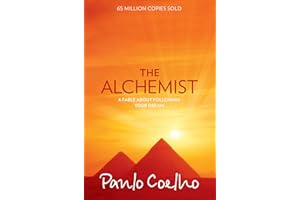
Review: The Alchemist by Paulo Coelho
In a Nutshell
A shepherd boy's allegorical journey to find treasure teaches him to listen to his heart and decipher the universe's omens, realizing the treasure was the journey itself.
"The Alchemist" is a book that whispers profound truths in the language of fables, a perennial bestseller that has touched millions with its deceptively simple narrative of a shepherd boy's journey. Coelho taps into a universal yearning for purpose, reminding us that the greatest treasures are often found not at the destination, but along the winding path of our own making. It’s a testament to the enduring power of myth and the human spirit’s innate drive to seek its ‘Personal Legend.’
The novel follows Santiago, a young Andalusian shepherd who dreams of finding a hidden treasure at the Egyptian pyramids. His quest, however, is far more than a physical journey; it is an allegorical pilgrimage into the heart of self-discovery. Guided by omens, mentors, and the quiet voice of his own soul, Santiago learns to decipher the universe's language, overcome fear, and understand that the pursuit of one's destiny is the ultimate fulfillment. The book argues that the entire universe conspires to help those who bravely pursue their dreams, a concept it terms the ‘Soul of the World.’
What works beautifully in "The Alchemist" is its profound accessibility. Coelho's prose, translated masterfully, possesses a lyrical quality that makes complex philosophical ideas digestible and emotionally resonant. The narrative structure, echoing ancient parables, imbues Santiago’s journey with a timeless resonance. It’s akin to reading a modern-day Aesop’s fable, where each encounter and setback serves as a lesson in resilience, faith, and the interconnectedness of all things. The simplicity is not a weakness but a strength, allowing the underlying message to shine through with clarity and impact, much like the spiritual parables found in the works of Khalil Gibran or the existential musings in Antoine de Saint-Exupéry's "The Little Prince." I found myself pausing often, reflecting on the parallels between Santiago’s journey and the often-unseen signs in my own life.
The book’s greatest strength lies in its potent optimism and its unwavering belief in the individual’s capacity to achieve extraordinary things. Coelho doesn't shy away from the idea that the path to fulfilling one's destiny will be fraught with challenges, often testing one's resolve. Yet, he consistently frames these obstacles not as insurmountable barriers, but as crucial stepping stones, designed to fortify the seeker and clarify their vision. The recurring motif of omens, the universe's subtle nudges, encourages a mindful engagement with the world, urging readers to be present and attentive to the guidance that surrounds them. This pervasive sense of hope and empowerment is undoubtedly why the book continues to resonate so deeply with a global audience.
However, "The Alchemist" is not without its areas for refinement. While the allegorical nature of the story is its charm, some readers might find the characters, including Santiago himself, to be somewhat thinly drawn archetypes rather than fully fleshed-out individuals. Their primary function often seems to be serving the philosophical message, which can occasionally make their motivations and emotional complexities feel secondary. Furthermore, the pacing, while generally effective in maintaining momentum, can feel a bit uneven in the latter half. Certain encounters and revelations, particularly those involving Santiago's romantic interests, sometimes lack the narrative depth to fully justify their impact on his transformative journey. A bit more exploration into the nuances of these relationships might have added another layer of richness.
Despite these minor points, "The Alchemist" remains a powerful and inspiring read. It serves as a potent reminder that the pursuit of our dreams is not a selfish endeavor, but a vital contribution to the harmony of the universe. It encourages us to listen to our hearts, to embrace the unknown, and to trust that the journey itself holds the true reward. This book is perfect for anyone feeling adrift, seeking direction, or needing a gentle nudge to pursue their deepest aspirations. Readers will walk away with a renewed sense of possibility and a profound understanding that their ‘Personal Legend’ awaits, not in some distant future, but in the unfolding moments of the present. It’s a fable for the modern age, reminding us that the greatest magic lies within our own courage to begin.
More Reviews
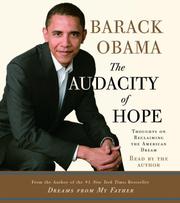
Review: The Audacity of Hope: Thoughts on Reclaiming the American Dream by Barack Obama
by Barack Obama
Review: Six of Crows by Leigh Bardugo
by Leigh Bardugo
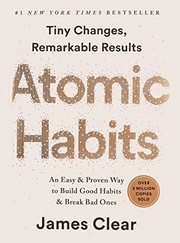
Review: Atom Habits: An Easy & Proven Way to Build Good Habits & Break Bad Ones by James Clear
by James Clear