
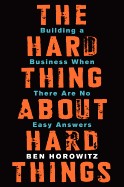
Review: The Hard Thing About Hard Things: Building a Business When There Are No Easy Answers by Ben Horowitz
In a Nutshell
Ben Horowitz’s "The Hard Thing About Hard Things" offers raw, honest insights into the brutal realities of leadership, eschewing easy answers for essential truths about navigating business crises.
There are plenty of books that promise to demystify the startup world, offering neat frameworks and aspirational narratives. Ben Horowitz's "The Hard Thing About Hard Things" offers no such comfort. Instead, it plunges headfirst into the brutal, often lonely reality of leading a company through its darkest hours, reminding us that the most critical decisions are rarely the easy ones.
Horowitz, a seasoned entrepreneur and venture capitalist, doesn't present a how-to guide in the conventional sense. Rather, he shares his personal experiences navigating the precipice of failure, the agonizing layoffs, the existential crises, and the sheer grit required to pull a business back from the brink. The book is a raw, unflinching chronicle of the leadership challenges that don't make it into the glossy tech magazines – the gut-wrenching trade-offs, the ethical dilemmas, and the constant, suffocating pressure.
What makes "The Hard Thing About Hard Things" so compelling is its radical honesty. Horowitz doesn't shy away from the messiness. He dissects the excruciating process of firing people he respects, the torment of realizing his own strategic missteps, and the deep emotional toll of being solely responsible for the livelihoods of hundreds. His prose is direct, devoid of corporate jargon, and often laced with a dark, self-deprecating humor that makes the profound insights even more impactful. I found myself nodding along, recognizing echoes of difficult moments in my own professional life, even in vastly different contexts. The chapter on "Peacetime vs. Wartime CEOs" is a particularly brilliant distillation of leadership styles, highlighting how the skills that propel a company forward in stable times can be disastrous during a crisis. He also masterfully illustrates how a CEO must be both the company's conscience and its unwavering shield, bearing the brunt of bad news so the team can focus on execution.
However, while the book’s relentless focus on the “hard things” is its greatest strength, it can also feel somewhat overwhelming at times. The sheer density of difficult scenarios might leave readers yearning for a more balanced perspective, perhaps a chapter or two exploring the triumphant moments and the strategies that led to genuine breakthroughs, not just survival. While Horowitz's personal anecdotes are invaluable, a broader range of case studies, even brief ones, could have further illuminated the universality of his principles. It's a testament to his storytelling that you are so engrossed in his journey, but occasionally I wished for a wider lens to see how these principles applied beyond his own experiences.
Ultimately, "The Hard Thing About Hard Things" is less a business book and more a masterclass in human resilience and the often-unseen burdens of leadership. It’s the kind of book you want to keep on your desk, dog-eared and highlighted, for those moments when the path forward seems impossibly steep. It will resonate deeply with anyone who has ever shouldered the weight of significant responsibility, reminding them that they are not alone in the struggle and that true leadership is forged in the crucible of adversity. This is not for the faint of heart, but for those who are ready to face the unvarnished truth of building something meaningful, it is an essential read.
Ben Horowitz’s "The Hard Thing About Hard Things" offers raw, honest insights into the brutal realities of leadership, eschewing easy answers for essential truths about navigating business crises.
More Reviews
Review: The Audacity of Hope: Thoughts on Reclaiming the American Dream by Barack Obama
by Barack Obama
Review: Six of Crows by Leigh Bardugo
by Leigh Bardugo
Review: Atom Habits: An Easy & Proven Way to Build Good Habits & Break Bad Ones by James Clear
by James Clear