
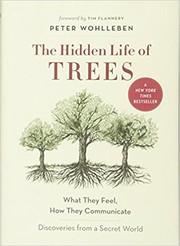
Review: The Hidden Life of Trees: What They Feel, How They Communicate—Discoveries from a Secret World by Peter Wohlleben
In a Nutshell
This groundbreaking book reveals the complex social lives, communication, and emotions of trees, transforming our perception of forests from silent entities to vibrant communities.
For anyone who has ever found solace beneath the rustling canopy of an old forest, Peter Wohlleben's "The Hidden Life of Trees" offers a profound revelation: those silent giants are not merely passive scenery, but vibrant, communicative beings with a complex social order. This isn't just a book about botany; it's an invitation to reconsider our place in the natural world, to listen to the wisdom whispered by the wind through ancient branches.
Wohlleben, a forester with decades of firsthand experience, takes us deep into the woods to unveil a world previously hidden in plain sight. He argues, with compelling evidence and infectious enthusiasm, that trees possess a form of intelligence, emotions, and a sophisticated network of communication that rivals many of our own societal structures. From the slow, deliberate way trees support their ailing brethren to their intricate methods of warning each other about danger, the book paints a picture of a forest as a superorganism, interconnected and interdependent. He explores how trees share nutrients through fungal networks, how parents nurture their young, and how they even engage in a kind of social grooming to protect themselves from pests.
What truly elevates "The Hidden Life of Trees" is Wohlleben's remarkable ability to translate complex scientific findings into accessible and deeply moving prose. He doesn't shy away from the scientific underpinnings, referencing studies and biological processes, but he weaves them into a narrative that feels more like a series of captivating anecdotes from the heart of the forest. His descriptions are so vivid – you can almost smell the damp earth, feel the rough bark, and sense the palpable presence of these ancient beings. The anthropomorphism, often a pitfall in nature writing, is here handled with a delicate hand; Wohlleben doesn't claim trees have human emotions, but rather that their behaviors and interactions serve analogous functions to the social bonds we understand. I found myself particularly struck by his exploration of "mother trees," ancient giants that act as central hubs, supporting and nurturing younger saplings in their vicinity, even if they aren't their direct offspring. It’s a concept that resonates with our own understanding of community and intergenerational care, yet is expressed through the slow, enduring language of wood and leaf. His comparisons to human society – the bullying behavior of some fast-growing trees, the collaborative defense against beetles – are not just illustrative; they invite a deeper empathy.
If there's a quibble to be made, it lies perhaps in the relentless optimism that pervades the latter half of the book. While Wohlleben’s passion for his subject is commendable and infectious, the occasional dip into what feels like a purely idealized portrayal of the forest can leave one wishing for a touch more exploration of the darker, more brutal realities of nature. The inherent competition and the stark finality of death within the ecosystem, while acknowledged, don't always receive the same nuanced treatment as the more communal aspects. Similarly, while the scientific explanations are generally clear, some readers might find themselves wishing for more detailed citations or a deeper dive into the methodologies behind the research presented. However, these are minor points in what is otherwise a profoundly engaging and enlightening work.
Ultimately, "The Hidden Life of Trees" is a transformative read that will fundamentally alter how you perceive the natural world. It’s a powerful testament to the interconnectedness of life and a gentle yet insistent call for us to become better stewards of the forests that sustain us. Wohlleben has gifted us a window into a secret world, one that has been silently unfolding around us all along. After reading this book, a walk in the woods will never feel the same; you’ll find yourself looking at each tree with a newfound respect, a quiet understanding of the ancient conversations taking place just beyond our human hearing. It’s a book that doesn’t just inform; it awakens.
This groundbreaking book reveals the complex social lives, communication, and emotions of trees, transforming our perception of forests from silent entities to vibrant communities.
More Reviews

Review: The Audacity of Hope: Thoughts on Reclaiming the American Dream by Barack Obama
by Barack Obama
Review: Six of Crows by Leigh Bardugo
by Leigh Bardugo

Review: Atom Habits: An Easy & Proven Way to Build Good Habits & Break Bad Ones by James Clear
by James Clear