
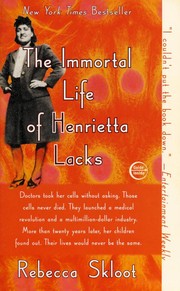
Review: The Immortal Life of Henrietta Lacks by Rebecca Skloot
In a Nutshell
This book chronicles the journey of Henrietta Lacks's immortal cells and her family's struggle for recognition and understanding.
Rebecca Skloot’s *The Immortal Life of Henrietta Lacks* doesn't just tell a story; it unravels a profound ethical and scientific mystery that echoes across generations. It’s a book that forces you to confront uncomfortable truths about medical progress, exploitation, and the enduring legacy of individuals whose contributions were largely unacknowledged, even unknown.
At its heart, the book chronicles the extraordinary journey of the “HeLa” cells, the first immortal human cell line, which were taken from Henrietta Lacks, a poor tobacco farmer, without her knowledge or consent in 1951. Skloot masterfully weaves together two parallel narratives: the scientific history of how these cells became one of the most important tools in medical research, and the personal story of Henrietta’s family, particularly her daughter, Deborah, as they grapple with the implications of their mother's unwitting biological immortality. It’s a dual exploration of the microscopic and the deeply human, the scientific breakthrough and its often-overlooked human cost.
What works so beautifully in Skloot’s hands is the sheer humanity she brings to a story that could easily have become a cold recitation of scientific facts or a dry ethical treatise. She spent over a decade immersed in the world of Henrietta’s family, earning their trust and allowing their voices to sing with a raw, often painful, authenticity. I found myself deeply moved by Deborah Lacks’s quest to understand her mother, a woman she barely knew and whose memory was inextricably linked to a scientific marvel she couldn’t comprehend. Skloot’s prose is fluid and engaging, capable of explaining complex biological processes with clarity while simultaneously conjuring vivid portraits of the people involved, from the dedicated scientists to the Lacks family members struggling with their unique inheritance. The narrative pacing is exceptional, seamlessly transitioning between historical accounts of HeLa’s discovery and its subsequent impact on medicine—polio vaccine, cancer research, AIDS, gene mapping—and the contemporary struggles of the Lacks family to claim their mother's legacy and understand their own genetic histories. It feels akin to the meticulous, empathetic historical storytelling of authors like Jill Lepore, but with an added layer of scientific intrigue.
If there’s an area where *The Immortal Life* could perhaps be seen as less than perfect, it’s in the sheer density of scientific information it imparts. While Skloot’s explanations are generally superb, there are moments where the biological details, though crucial to understanding the significance of HeLa, can feel a touch overwhelming for the lay reader. Similarly, while the book admirably highlights the Lacks family’s enduring pain and confusion, a deeper dive into the legal and societal structures that allowed for such exploitation, beyond the initial unethical collection of cells, might have offered an even more comprehensive indictment of the systemic issues at play. This is a minor quibble, however, in an otherwise impeccably researched and profoundly moving work.
The verdict on *The Immortal Life of Henrietta Lacks* is that it is a landmark achievement in narrative nonfiction. It’s a book that educates, enrages, and ultimately, deeply touches the reader. Anyone interested in the intersection of science and humanity, medical ethics, or simply a powerful true story of family and legacy will find themselves captivated. Skloot has given us not just the story of Henrietta Lacks, but a vital reminder of the countless unseen lives that underpin our world, a testament to the fact that even in the face of immense scientific progress, the human story must never be forgotten.
More Reviews
Review: The Audacity of Hope: Thoughts on Reclaiming the American Dream by Barack Obama
by Barack Obama
Review: Six of Crows by Leigh Bardugo
by Leigh Bardugo
Review: Atom Habits: An Easy & Proven Way to Build Good Habits & Break Bad Ones by James Clear
by James Clear