
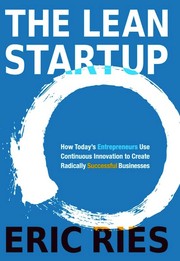
Review: The Lean Startup: How Today's Entrepreneurs Use Continuous Innovation to Create Radically Successful Businesses by Eric Ries
In a Nutshell
Eric Ries's 'The Lean Startup' offers a practical framework for entrepreneurs, emphasizing iterative innovation, customer feedback, and validated learning to build successful businesses efficiently.
It’s a curious paradox: the most celebrated innovations often arise not from grand, sweeping visions, but from humble, iterative adjustments, from a relentless questioning of assumptions. Eric Ries’s *The Lean Startup* doesn’t just identify this principle; it weaponizes it, offering a potent framework for navigating the treacherous waters of entrepreneurial ventures. This isn't a book of overnight success stories, but of deliberate, data-driven evolution.
At its core, *The Lean Startup* is a manifesto for a more efficient, less wasteful approach to building businesses, particularly in the realm of technology and product development. Ries champions a methodology he calls the "lean startup," which emphasizes rapid prototyping, continuous testing, and a scientific approach to understanding what customers truly want. The central tenet is the "build-measure-learn" feedback loop, a cycle designed to accelerate learning, minimize wasted resources, and pivot when necessary, rather than stubbornly pushing a flawed product to market. It's about treating every startup as an experiment, constantly seeking validation for hypotheses about customer needs, business models, and product features.
What works beautifully in *The Lean Startup* is Ries's ability to distill complex management and product development concepts into accessible, actionable principles. He doesn’t just present theory; he grounds it in compelling anecdotes from real-world companies, both successes and failures, like Intuit and Dropbox, demonstrating the practical application of his ideas. The prose is clear, direct, and surprisingly engaging for a business book. Ries possesses a knack for framing concepts like "validated learning" and "minimum viable product" (MVP) in a way that demystifies them, making them feel less like jargon and more like essential tools. I found myself frequently nodding along, recognizing patterns of inefficiency I’d witnessed or experienced in various professional settings. The book’s strength lies in its sheer practicality; it offers a roadmap, not a magic bullet, for entrepreneurs feeling overwhelmed by uncertainty.
Furthermore, the book’s emphasis on a scientific, hypothesis-driven approach to business is a refreshing antidote to the often-romanticized notion of the lone genius founder with a singular, world-changing idea. Ries argues persuasively that success is less about innate brilliance and more about rigorous process and disciplined iteration. This perspective is particularly valuable in today's fast-paced, ever-changing market, where adaptability is paramount. The concept of the MVP, for instance, is elegantly explained as a way to get real customer feedback with the least amount of effort, preventing the costly mistake of building something nobody wants. It’s akin to the meticulous experimentation seen in scientific research, applied to the messy, dynamic world of business.
Where *The Lean Startup* could perhaps be stronger is in its exploration of the psychological toll that this constant iteration and potential for pivoting can take on founders and teams. While the book acknowledges the need for agility, it sometimes glosses over the emotional resilience required to repeatedly face potentially disappointing feedback and make significant strategic shifts. For some readers, the relentless focus on metrics and data might also feel a touch cold, potentially overshadowing the human element of building a company and fostering a strong team culture. While innovation is central, the nurture and care required for a team to thrive under such a demanding framework could have been explored more deeply. A few more case studies delving into the team dynamics during periods of intense iteration might have added another layer of richness.
Ultimately, *The Lean Startup* is an indispensable guide for anyone looking to build or grow a business in the modern era. It’s not just for tech entrepreneurs; its principles are applicable to any venture that requires innovation and customer validation. Ries provides a powerful toolkit for reducing waste, increasing the odds of success, and fostering a culture of continuous improvement. You’ll walk away with a clearer understanding of how to build products that matter, and more importantly, how to learn quickly and adapt along the way, transforming uncertainty into opportunity. It's a book that doesn't just teach you *how* to build a business; it teaches you how to learn from building it.
More Reviews

Review: The Audacity of Hope: Thoughts on Reclaiming the American Dream by Barack Obama
by Barack Obama
Review: Six of Crows by Leigh Bardugo
by Leigh Bardugo
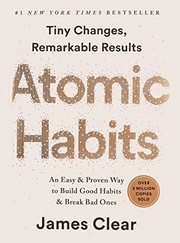
Review: Atom Habits: An Easy & Proven Way to Build Good Habits & Break Bad Ones by James Clear
by James Clear